 Standard of Practice: Professional Learning, Subsection 5 – Teachers know their subject matter, the Ontario curriculum, and education-related legislation.
Program Theme: Professionalism, Law, and Ethics
Context
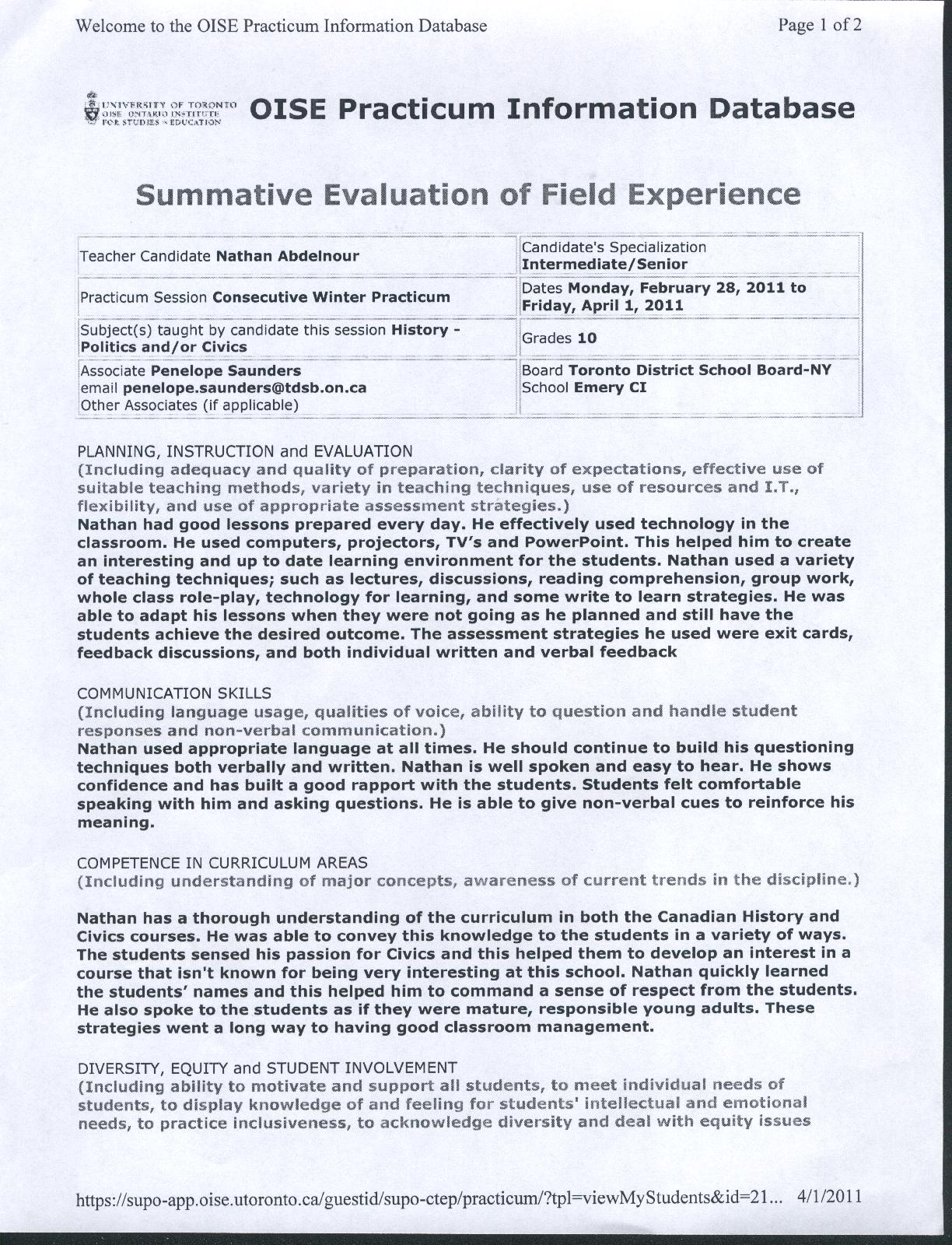
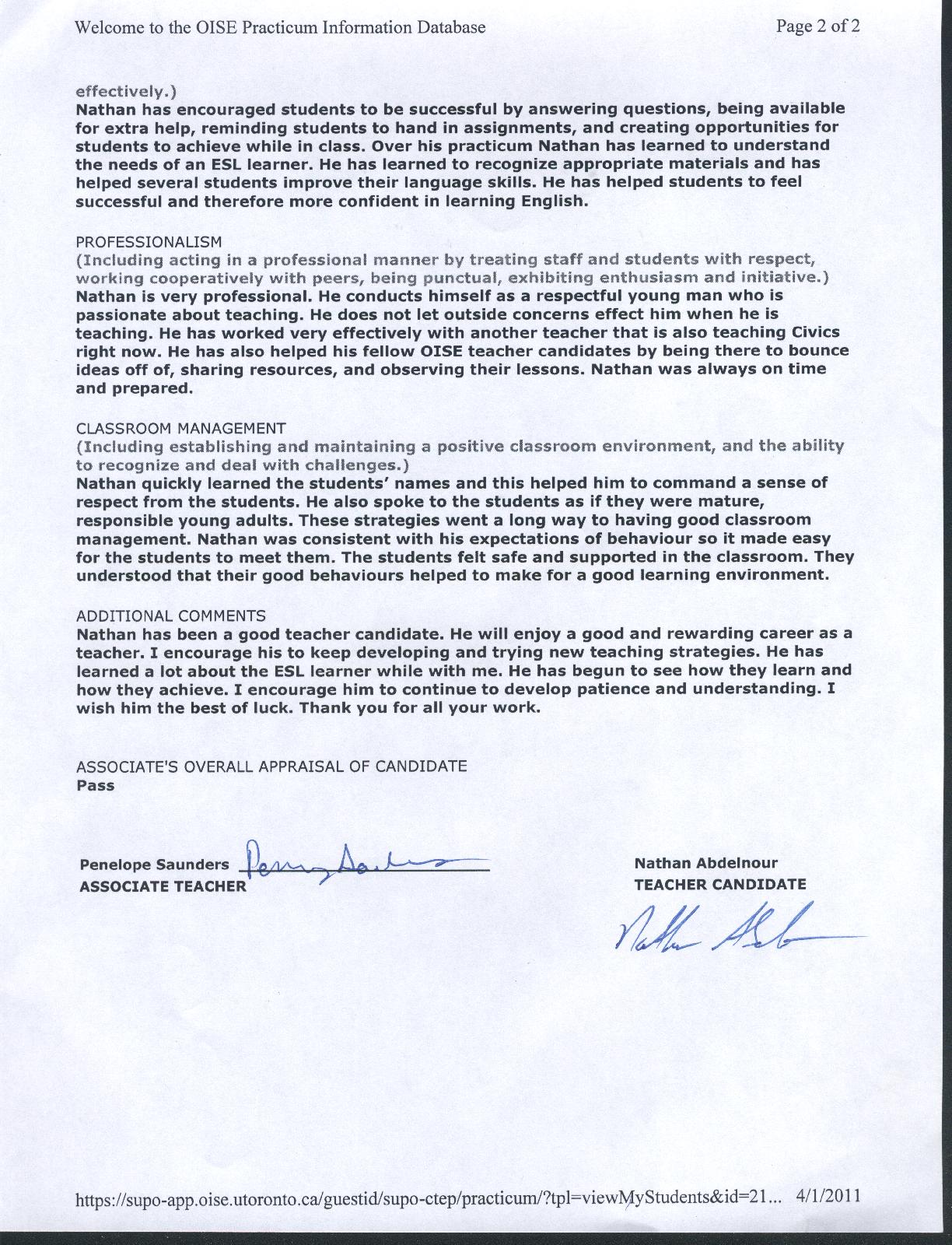
My second practicum placement of the year took place at Emery Collegiate Institute under the tutelage of my Associate Teacher. The reason I used my summative evaluation as an artifact is
because of the amount of work that went into getting a positive evaluation. In all honesty, although I had an AT who was unbelievably helpful and inspirational, my first placement at Vaughan Road Academy in the INTERACT program did not offer me the types of challenges as my second placement did.
 My time at Emery Collegiate tested my competencies as an educator and my strategies to try and help foster a positive learning environment that would promote student success. In addition to having to battle the negative school atmosphere when it came to student success, I was also teaching an ESL History class, something I had never done before. By the end of my month at Emery I had come to garner a deeper understanding of some of the legal requirements of the teacher, as well as the basis through which the Ontario College of Teachers’ Foundations of Professional Practice were created. All of these requirements have become a part of my own moral obligations to students, and for that reason I have a full appreciation for my experience as a student teacher at Emery Collegiate.
Process
From the very outset of my placement I began teaching the two classes I would be a part of: Grade 10 Civics and Grade 10 ESL History. I also participated and did my best to help my AT with her third section, an ESL Drama class. Right away I became aware of the diversity found within the classroom, and, most notable, the differences between the abilities of mainstream and ESL students. My biggest challenge became finding material in the various subjects that was appropriate for their level of understanding. This was especially the case for the ESL History class. However, I had a lot of help from my AT who would let me try different strategies, even if she knew they were going to fail. The other difficulty I had was in finding different ways to engage the ESL students with the material while maintaining a need for knowledge and understanding. Over the course of the practicum, however, I found that certain in-class reading strategies really seemed to work to keep them engaged with the material. Luckily, I was able to diversify my methods and strategies with the Civics class, who were more or less participating in class throughout my time with them.
Much more difficult of a task for me was to navigate between the school atmosphere and teacher expectations, the school late and attendance policies, and my obligation to try and set up the best possible learning environment for these students. Ironically, this problem applied mostly to the Civics class, though there were a few students in the History class for whom these issues persisted as well. There were more than just a few instances where students would arrive significantly late for class, and even some cases where a few students would show up once a week, if I was lucky enough to see them that often. These tendencies began to wear on me during practicum as my frustration level began to increase. Yes, I was frustrated at the students, but also at myself for not being able to find a way to have them come to class.
Learnings
As my evaluation demonstrates, my AT felt as though I had a good grasp of classroom management and of helping students with an ESL background achieve success. She also mentioned how my willingness to accommodate students with late assignments and staying late after school to help them succeed was of great benefit not only for the students, but for me as an educator as well. As I reflect on my practice, though, I wonder what else it is that I have learned. On a more fundamental level, I believe it is fair to say that my time at Emery truly helped me forge my educational philosophy. Part of the problem with the students I was having the most difficulty with was that there seemed to be little ownership on their part for their own learning. As my philosophy states, I want to be able to have students step up and meet the challenge of my expectations. It is incumbent for students to take ownership and responsibility for their actions if they expect to have any success.
The reason this revelation was a big deal for me is because of the frustrations I exhibited early on in my practicum. My reactions to students walking in half way through class and being disruptive did not express a sense of care and empathy for the students. Nor did it offer an opportunity to have the student learn from the experience and alter their behaviour. Given all of this, how could I ever hope that they would not only meet my expectations, but to exceed them? Unfortunately, by the time I did come to the realization that my actions were probably not having the most positive influence on those students’ ability to succeed it was too late to reverse the trend. Such alterations in behaviour require a fundamental shift in a student’s attitude, and these changes can only happen over a prolonged period of time.
Goals
After having gone through my practicum experience at Emery I was able to define my own educational philosophy more coherently. The reasons behind which the Ontario College of Teachers predicates certain ethical practices also became much clearer to me. As such, my own philosophy has made such ethics of care an integral part of my practice. I truly feel as though student success is predicated on their own desire to want to do well. In order to have them want to step up to meet my expectations, they must feel as though they can trust me. Would they ever be able to trust someone who does not care for their well-being? Probably not.
As I have already stated, one month is not nearly enough time to help students begin to alter their behaviour and habits in an effort to foster a positive cycle of success. At the same time, I believe I have a clearer understanding for how I want to structure my own class from the very start of the school year. Firstly, the notion of designing curriculum backwards is a key component as it allows me to identify the key learning and outcomes students will acquire prior to even teaching. This entire process, though, means little if the students are not immediately made aware of these expectations. When they know what they are learning and for what purpose they are learning it prior to beginning the class, unit, or course, it makes the process that much smoother.
Furthermore, I would insist on setting up a class list of rules that the students themselves came up with, including the consequences for not adhering to those rules. Again, this allows students to take ownership of their own learning by designing the learning environment they will be working in on a daily basis. In addition, this outline of rules and expectations in the classroom will serve as a point I can turn to throughout the course to ensure the students are following through. Finally, I will also look to have students submit weekly reflections. Part of this reflection, though not limited to, will be an analysis of academic achievement and a plan of attack to which they will be held to account. Hopefully, these measures will help ensure that students accept my invitation to participate and engage with the course material.
 Footprints In The Mud