 Standard of Practice: Professional Practice, Subsection 9 – Teachers use their professional knowledge and understanding of pupils, curriculum, legislation, teaching, practices, and classroom management strategies to promote the learning and achievement of their pupils.
Program Theme: Diversity, Equity, and Social Justice
Context
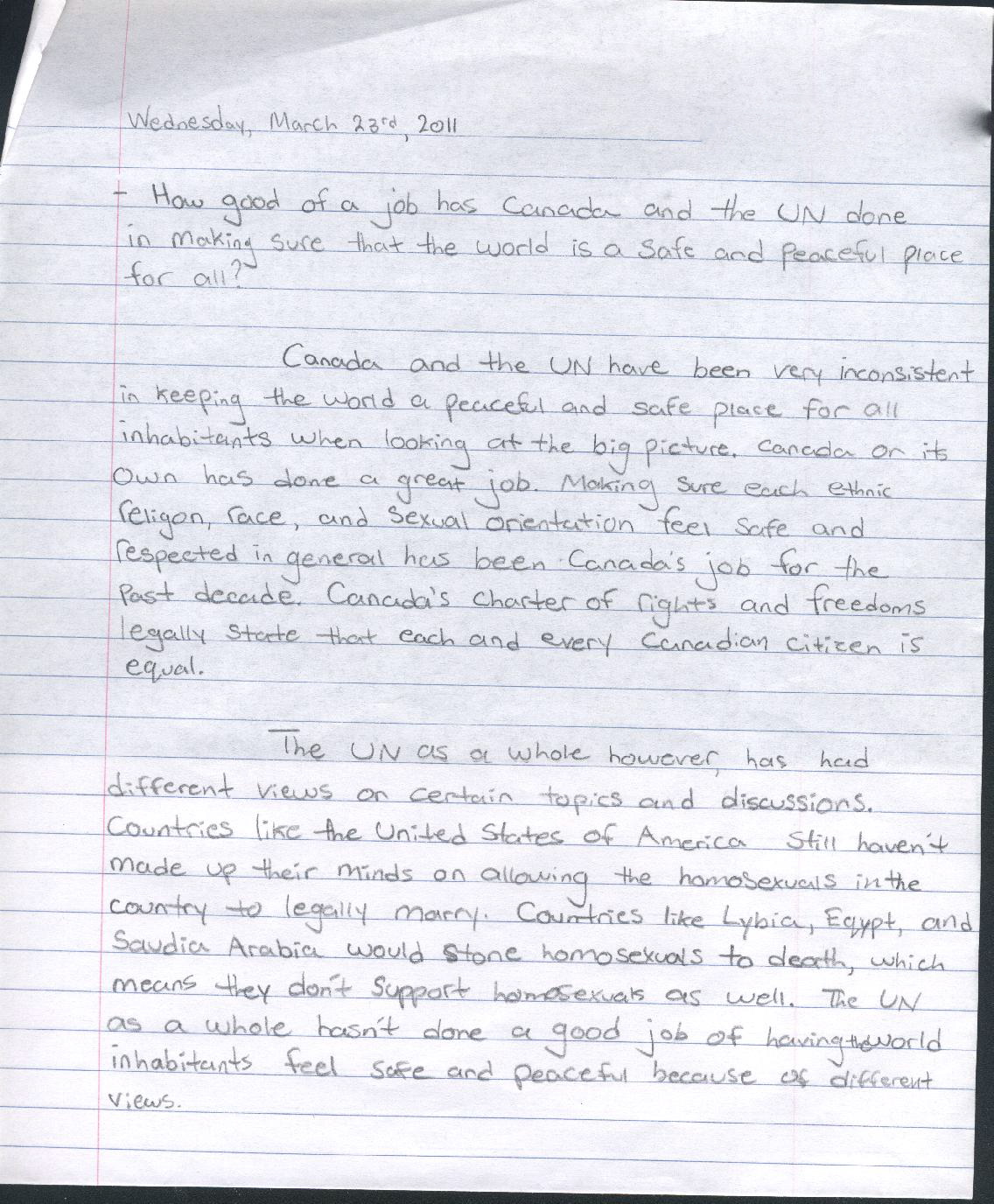
For this entry, the artifact I have decided to use is a student’s response to a question posed following a lesson during my second practicum placement at Emery Collegiate Institute. The responses were part of an assessment strategy to see whether or not students had understood the material presented to them concerning international human rights. The goal was to have students decipher whether or not Canada and the United Nations, either together or separately, have done enough to protect individual human rights on the international stage. This was part of the Global Citizenship portion of the Grade 10 Civics class.
As exemplified by the answer given above by a student with an exceptional understanding of the material, the majority of the class appeared to have a working knowledge for the role Canada and the UN has in protecting individual rights on the international stage, successfully or not. It was a proud moment for me as it was the first assessment tool I had used that reflected student understanding of the material. More importantly, though, it was on a topic that generated quite a bit of discussion within the class, especially on the day our guest speaker arrived to talk about gay rights both at home and abroad. I felt as though I was able to address issues of social justice on a global level, give it a face, make it relevant, and get the students engaged. It was probably my best lesson of practicum, or at least, the one that had the most impact upon the students.
Process
I wanted to make the second unit on Global Citizenship in the Civics class a little more relevant to the students. I came into practicum half way through the first unit, which was more or less laid out for me by my AT in terms of topics. However, it was the first time she had ever taught the course, and she had limited resources at our disposal. I decided to work with the other Civics teacher in the department that semester to see what we could hash out for the students. As we progressed through the first unit and into the second, we wanted to be sure to address issues of social justice and human rights. However, we could not plan everything together, as he had two sections to my one, and much bigger classes. As such, I was able to progress much more quickly through some content, and it ended up freeing a period for me to do something different with.
When we arrived to the topic of international human rights, I decided to spend two days on the topic and have a guest speaker come in on the second day. We began by doing an activity around specific international conflicts, both past and present, that were based on some form of abuse of human rights. The students were asked to watch a video on the role of Canada and the UN during the Rwandan genocide, as well as read an article concerning the crisis in Darfur. In addition, as a class we examined Canada’s very first peace keeping mission in Egypt during the 1960s and our current role in Afghanistan. Students were then asked to identify the criteria for success or failure in each case and how that might have affected Canada and the UN’s desire to engage in further peace-keeping missions. For homework I had the students read through a few of the clauses in the United Nations Declaration on Human Rights, paying special attention to the language used in the document.
On the second day I had my younger brother, who has been openly gay since he was 12, come in to the class and speak for 30 minutes and take questions. Prior to his beginning, I made it clear to the class that he did not have to explain his sexual orientation to anyone, but rather his purpose was to give a first hand account of how different countries and cultures approach the issue during his travels overseas as a professional ballet dancer. The students were respectful and ended up asking some very insightful questions. Finally, we looked at the wording in the UDHR, and noticed that sexual orientation is not specifically mentioned as a basis by which individuals cannot be discriminated against, though it is specifically outlined in the Canadian Charter of Rights and Freedoms. With all of this information, students were then asked to write a one paragraph response to the question “how good of a job has Canada and the UN done in making sure that the world is a safe and peaceful place for all?”
Learning
As I mentioned above, I truly believe this was the lesson or activity that the students were most engaged by. They were all extremely attentive during my brother’s presentation, and seemed genuinely intrigued, and in some cases outraged, by what they had discovered was happening overseas as well as here at home. My brother’s experience here in Canada has not always been the most pleasant, though he has certainly taken it all in stride, a characteristic even the students acknowledged. It was interesting to note, though, that the students who had made the most noise about a homosexual coming into the classroom ended up being the most willing to engage in a discussion with my brother, while those who I would have expected more out of during the discussion were unwilling to even engage eye contact with him.
I think I gained two really key learnings though. The first is that students, when challenged, can truly rise to the challenge. That makes teaching controversial issues in the classroom so much easier. Their willingness to engage with the content and my brother has me wanting to do that lesson over and over again. At the same time, I also learned that education and learning happens even to those who are not the students. My brother is younger than I am, and had never spoken to a crowd about his experiences as a homosexual before. I am most proud of the fact that I was able to provide a learning environment for both my students and my brother. There were definitely things he would want to work on for next time, but I would ask him back into my classroom in a heartbeat.
Goals
The biggest thing I took away from the experience of this particular lesson is the fact that I really want to make more of an effort to have controversial issues be a focal effort in my teaching style. First of all, I find that such topics of discussion raise the expectations of students. They are required to act in a respectful manner, to be mindful of the fact that what they say in class can have a significant impact upon a fellow classmate. The opposite, of course, being to simply covering “boring” material, such as the structure of the House of Commons through the textbook, and not offering students a chance to do anything more with the information. Also, increasing this level of expectation forces students to behave in a more engaging and positive manner, traits that will only help them become aware of their conduct and help them achieve a better understanding of the material. Ultimately, this would lead to strong academic success.
It is incumbent upon myself to offer these opportunities to students. They must see that I am not afraid of discussing these issues with them, and that will hopefully have them take ownership of their own behaviour and attitudes towards learning. Forcing students to take part in such discussions is crucial for their success, and it is something I want to be a part of my practice on a regular basis.
 Footprints In The Mud