 Standard of Practice: Ongoing Professional Learning, Subsection 16 – Teachers engage in ongoing professional learning and apply it to improve their teaching practices.
Program Theme: Assessment and Evaluation
Context
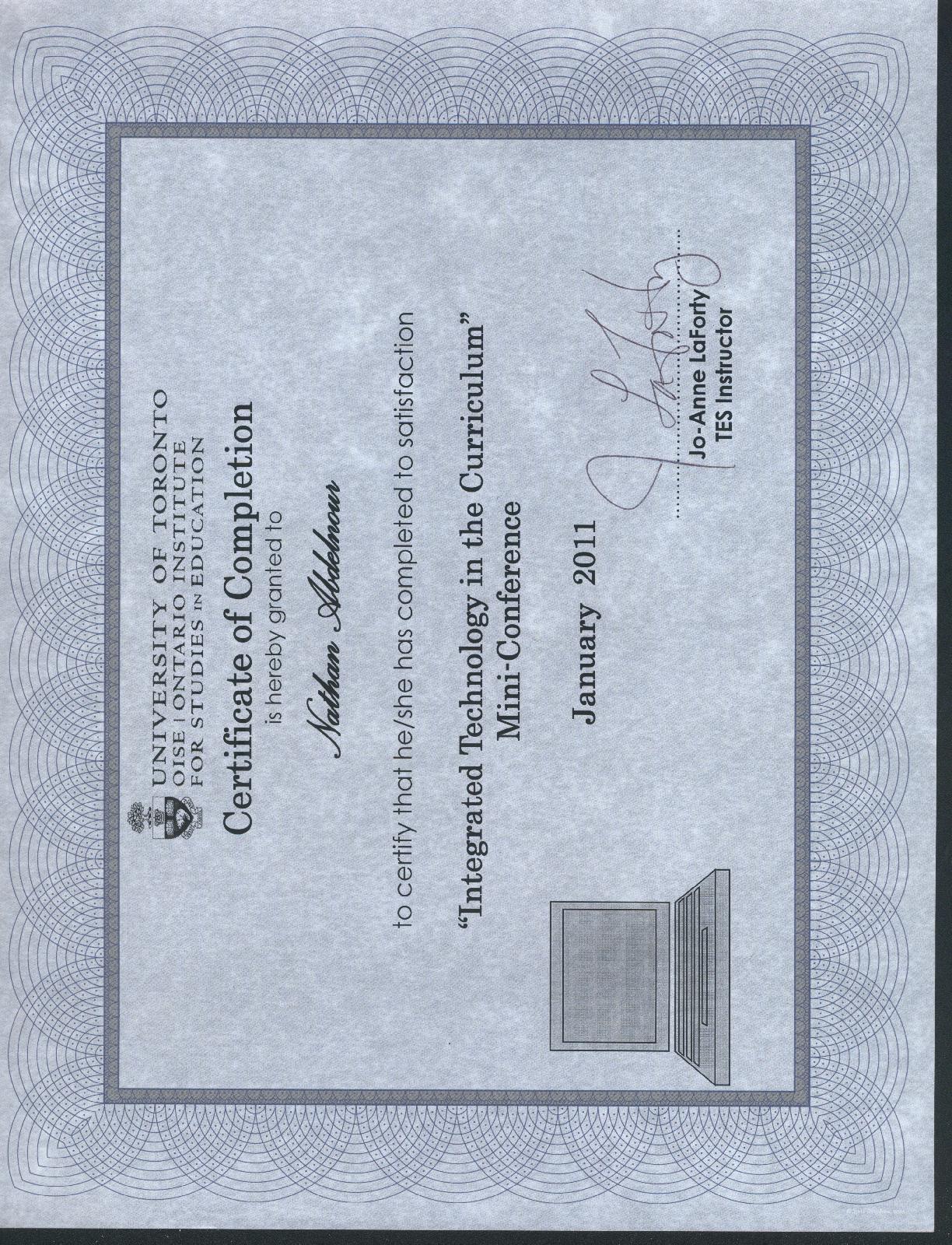
As part of my professional portfolio, I have acquired a certificate of attendance to a conference called Integrating Technology in the Curriculum. It was held throughout the morning on January 24th, 2011 at OISE, and offered a number of mini workshops that teacher candidates could attend. I signed up for Podcasting in the Classroom, Wikispaces and You Tube, and Smart Ideas. These individual workshops provided a great opportunity for us as new teachers coming into the profession to grasp how it is that technology can be used in the classroom to help student learning.
In terms of professional learning, this was an excellent way for me to learn more about the new ways in which current technology is being used in the classroom. In fact, I am familiar with many of the programs being used, I was simply unaware that they could be used in such a way. More importantly, though, the sessions on Podcasting in the Classroom provided a new and different way to approach assessment and evaluation. When combined with the learnings from the Wikispace and YouTube session, these particular technologies offer an incredible opportunity to have students present their product in a unique way and to a much larger audience. As I continue to invest my own time to improving my skills with different technological pieces, hopefully I can effectively use these assets to help promote student success. Diversifying my own expectations will also allow for that many more students to engage themselves with the material in order to produce a final product that goes above and beyond those expectations.
Process
The morning of January 24th, 2011 was quite busy indeed. It is unfortunate that we only had enough time to participate in three workshops, but those I did attend provided me with a wealth of useful material. The session on Podcasting in the Classroom I found to be particularly useful. The presenter went to great lengths to outline how podcasting has become a part of his everyday routine in the classroom. It certainly helped that his entire presentation was based on the use of a Mac laptop, which is what I also use. More importantly, though, the presenter’s focus was on how podcasting could be used for purposes of assessment and evaluation. I will go into more detail below, but when combined with the ideas presented in the next session, it gave me a few ideas of my own on how to use these technologies in my classroom.
Following that I attended the Wikispaces and YouTube session. The facilitators here outlined the means by which the Wikispace website can be used to help with student learning. It offers a unique method for students to engage with the material, but more importantly, it also offers them an opportunity to continue their learning through dialogue and discussion outside of the classroom. In addition, the session offered quite a bit of information on how to integrate YouTube clips into lessons, and even how to embed these videos into the Wikispace page. Again, this offers students the ability to interact with the material in a different way, which can be a huge asset to those students who are more visual learners.
Finally, I attended the Smart Ideas workshop to close out the conference. In all honesty, though I believe the program has a lot to offer, I thought it was the least progressive of the technologies presented. It did not provide me with a sense that the students would be able to get that much more out of the experience than if they were able to produce and publish their work in an online forum. Nonetheless, Smart Ideas as a program would certainly be useful for those students who might otherwise have difficulty organizing their thoughts and ideas on paper. In addition, it does provide yet another method for students to scaffold their own work.
Learning
Without a doubt, what I came away with following the conclusion of the conference was the notion that technology can and should be used in ways other than simply showing PowerPoint presentations and DVD movies. In fact, it can be an integral part of the assessment and evaluation process. After having gone through two practicum placements in the Toronto area, I have come to see just how difficult and stressful the standard written test can be on students. The amount of study time and memorization that goes into preparing for, say, a history test, can be excruciating. Allowing for podcasts to be a part of the evaluation process can help alleviate some of the stresses on students, providing them with an opportunity to demonstrate their knowledge and understanding in a manner that is more enjoyable.
I personally have no qualms with making the classroom a fun place to be. In fact, as it pertains to my own educational philosophy, my role is simply to facilitate student learning. I have my set of expectations that every student must meet, but my ultimate goal is to have them exceed those expectations whenever possible. Part of my role is to address the various needs of the students in my classroom. Using technology, and specifically podcasting and publishing capabilities, allows me to have those visual and kinesthetic learners connect with the material and hopefully even complete a task or product that they are impressed with.
For me, they key is to have this podcasting technology combined with the publishing capabilities of Wikispace and YouTube. For instance, we as teachers often try to have students role play in order to try and get a better understanding of the material. Well, why not have students record their skits and simulations on the role of Parliament in the passing of a bill into law? Not only would students be more willing to put on a good performance, but by knowing that the final product would be viewable online, they would also ensure their actions reflect accuracy in their interpretation of their particular role.
In terms of the evaluative process, recording such simulations would allow for the educator to be engaged with students throughout, offering them a sense of comfort. Once completed, the teacher can then go back and assign a mark to every individual after viewing the recording. That way, the anecdotal evidence of student understanding required in such evaluations will reflect far more scrutiny and insight and provide students with more concrete feedback to help with their learning. Furthermore, I believe peer feedback is absolutely essential to helping students take ownership of their work. As such, through an online forum, opportunities for anonymous and private peer feedback provide yet another avenue for students to try and identify their weaknesses and points to address for the next time.
Goals
At the end of the day, I want to be sure that I have offered every student and opportunity to achieve up to his or her maximum potential. A part of that process includes not only differentiating my teaching techniques and strategies, but also my methods of assessment and evaluation. The use of podcasts and the possibility of posting such recordings onto a class Wikispace page offers me the unique ability to mix it up and challenge students in new way.
In my educational philosophy I discuss how I want to invite students to step up and perform at the level of expectations I have set. This requires ownership on the part of the student to achieve their target goals. Podcasting can be a tool used to help them assess their own weaknesses and struggles, much like a referee coach will provide the referee with a video of their previous match as part of the post-match reflection process. Furthermore, using these technologies offers educators the ability to truly evaluate student understanding by viewing the final product one or two more times. I would even like to take up some the sessions with the entire class, having peers identify problems and issues, a form of self-coaching. All of these techniques would greatly help me become a better educator, and help students better achieve their goals.
 Footprints In The Mud